
How to Connect A Diesel Generator to Off-Grid Solar PV System in the Winter

Install Solar Panels on Flat Roof Without Tools – Gaia Rubber Mounting Kit
August 10, 2025
How to Connect a Diesel Generator to an Off Grid Solar PV System in Winter
Winter brings shorter days, low sun angles and frequent overcast skies. Even a well designed off grid solar PV system can struggle to fully recharge batteries during prolonged cold spells.
When using a diesel generator as backup, it is essential that the generator is correctly sized. As a rule, the diesel generator must be at least 1.5 times the rated power of the inverter.
For example, a 5 kW inverter requires a minimum 7.5 kW diesel generator, while an 11 kW inverter requires at least a 16.5 kW generator. Correct sizing ensures stable operation, reliable battery charging and prevents generator overload during high surge currents.
In this blog, we focus on off grid systems with 11 kW inverters or larger, where users have already purchased a small diesel generator that is not powerful enough
to support a large inverter and feed heavy loads directly. This is a very common real world scenario.
Why a Diesel Generator Is Still Important in Winter
Solar panels produce significantly less energy in winter, especially in the UK climate. Heating loads, lighting and essential appliances continue to demand power.
A diesel generator acts as a controlled support source, recharging batteries when solar input is insufficient and preventing deep battery discharge that shortens battery life.
The Problem With Big Inverters and Small Generators
Large off grid inverters can draw substantial power when charging batteries and when supporting loads at the same time.
If the generator is undersized, it can struggle with surge currents, voltage dips, unstable frequency and nuisance shutdowns.
This becomes even more challenging in parallel systems. For example, 2 x 11 kW inverters can require a generator of around 35 kW to reliably support charging plus loads,
which can be expensive to buy, install and run.
The Practical Solution: Use a Small Generator for Charging Only
To make use of a small diesel generator when you have a combined inverter and charger system, the best approach is to add a smaller inverter that will be used
exclusively as a charger in backup conditions. This allows the small generator to run in a stable, efficient way without needing to support the full household load.
A proven example is using a 7.5 kW generator together with a 5 kW MPPT charger at 48 V, activated only in emergency conditions to recharge the battery bank.
Once the batteries are fully charged, the generator is switched off, and the system returns to normal solar and battery operation.
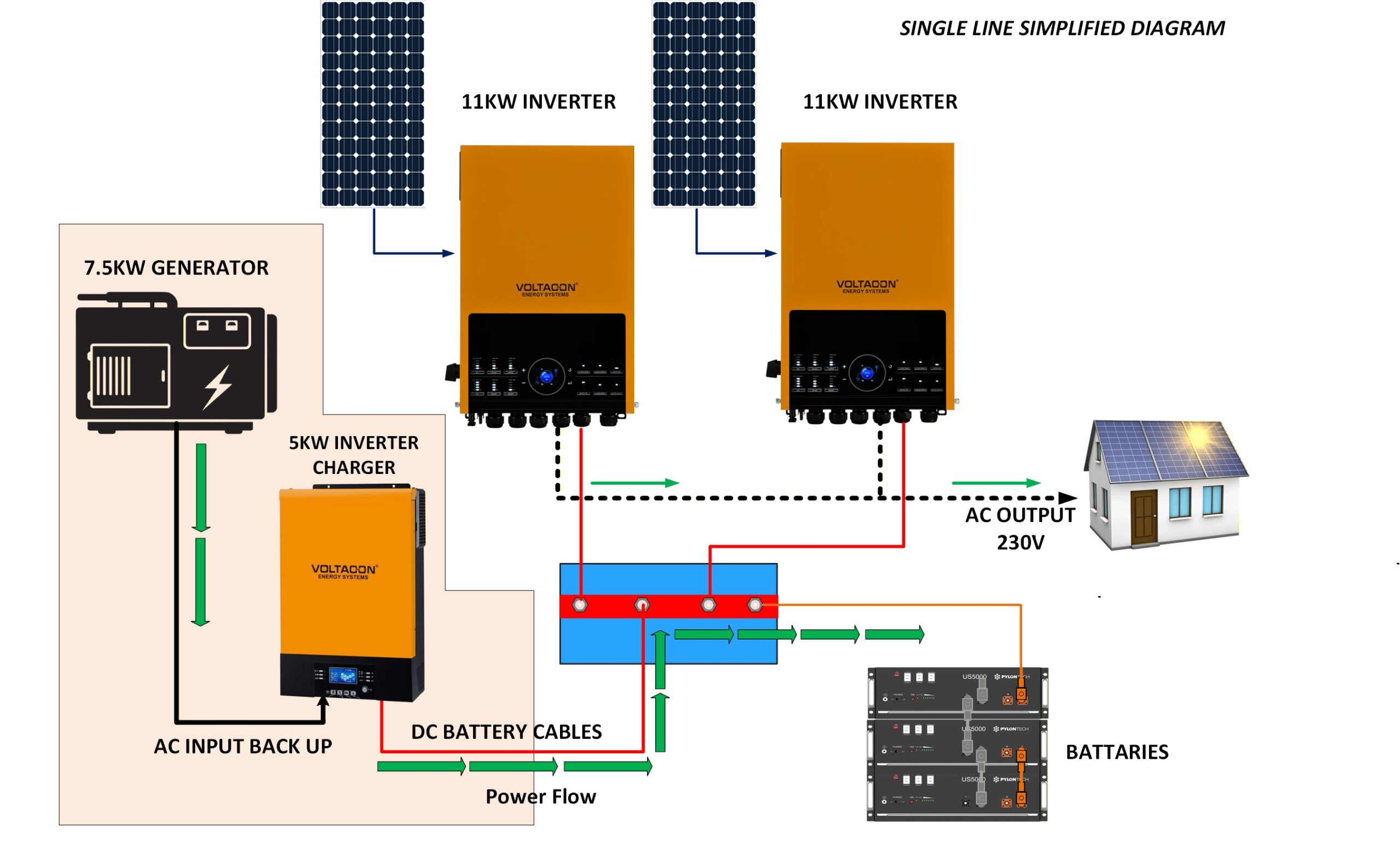
How the Generator Integrates with an Off Grid System
Most modern off grid inverters include a dedicated AC input for a generator. When battery voltage drops to a preset level, the inverter automatically starts the generator
or signals it to start. The inverter then uses the generator to supply loads and recharge the battery bank at the same time.
Key Connection Principles
The generator must never be connected directly to household circuits without passing through the inverter or a proper changeover system.
The inverter synchronises voltage and frequency, protects sensitive electronics and controls charging current to suit lithium or lead acid batteries.
Correct earthing and bonding are essential to ensure safety and stable operation.
Smart Generator Use for Fuel Efficiency
Rather than running the generator continuously, it is best used in short, efficient charging cycles.
Many inverters allow time based or voltage based generator operation. This approach reduces diesel consumption, noise and maintenance while keeping batteries in their optimal state of charge.
A Reliable Winter Power Strategy
Combining solar PV, battery storage and a diesel generator creates a resilient energy system. Solar handles everyday generation, batteries provide silent power overnight,
and the generator steps in only when truly needed. This balanced approach guarantees uninterrupted electricity throughout winter while keeping running costs under control.
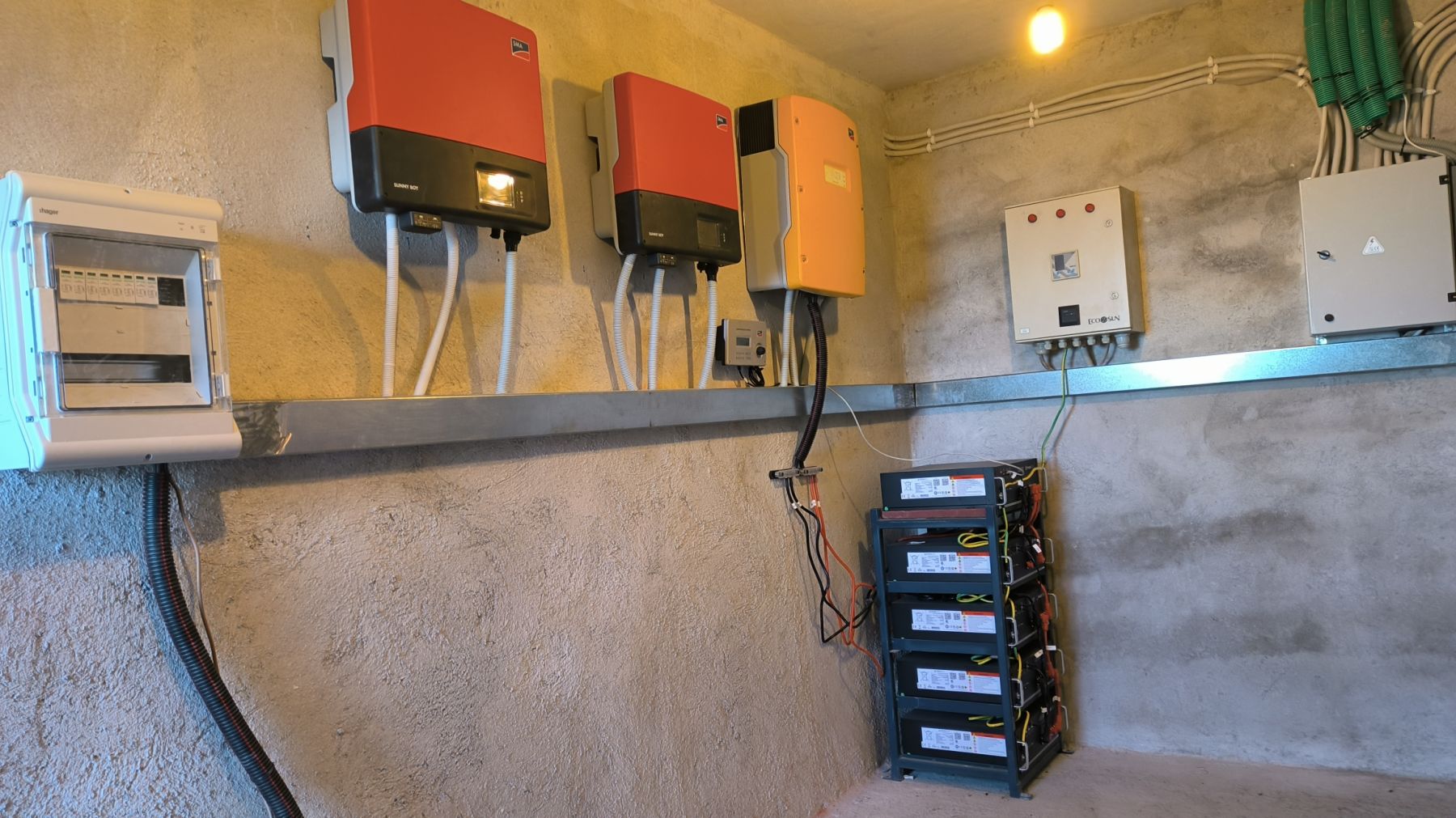
Off grid system with SMA inverter, ATS (automatic transfer switch) , SUNNY Island and Pylontech
